
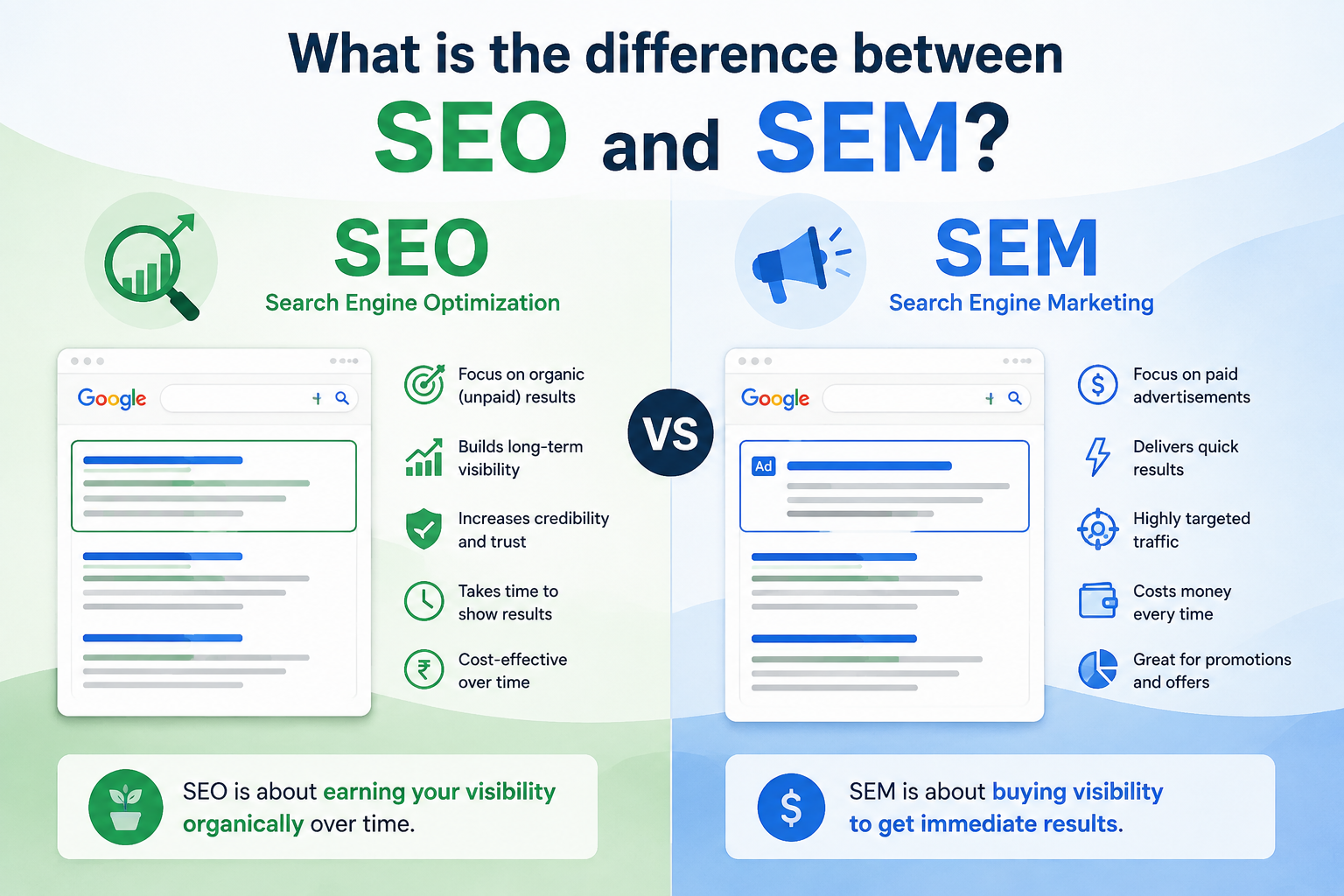
What is the Difference Between SEO and SEM? The Ultimate Digital Marketing Guide for 2026
When building a robust digital marketing strategy, business owners, founders, and marketing professionals frequently encounter two acronyms that form the backbone of modern search engine visibility: SEO (Search Engine Optimization) and SEM (Search Engine Marketing).
While these terms are occasionally used interchangeably in casual conversation, they represent distinct approaches, methodologies, and financial models for capturing targeted traffic from search engines like Google and Bing. Understanding the nuances between SEO and SEM is vital for allocating marketing budgets effectively, maximizing return on investment (ROI), and scaling brand awareness online.
This comprehensive guide explores the core definitions, mechanical differences, financial implications, and strategic synergies of SEO and SEM, empowering you to build an integrated search engine strategy that drives sustainable business growth.
1. Defining the Core Concepts
To understand how SEO and SEM interact, we must first establish precise definitions for each discipline.
What is SEO (Search Engine Optimization)?
SEO is the strategic process of optimizing a website and its surrounding digital ecosystem to improve its organic (unpaid) visibility on search engine results pages (SERPs). When users type a query into Google, algorithms scan billions of indexed pages to deliver the most relevant, authoritative, and high-quality results.
SEO focuses entirely on earning these top placements naturally through technical excellence, high-value content creation, and authoritative link acquisition, without paying search engines directly for placement clicks.
What is SEM (Search Engine Marketing)?
SEM is a broader umbrella term that encompasses all marketing activities undertaken to increase a website’s visibility within search engines. Historically and practically in modern digital marketing, SEM specifically refers to paid search advertising—often synonymous with Paid Search or Pay-Per-Click (PPC) advertising through platforms like Google Ads and Microsoft Advertising.
Under this modern definition:
2. Key Differences Between SEO and SEM
While both disciplines share the ultimate goal of driving high-intent traffic from search engines, they differ fundamentally across several operational dimensions.
| Feature | SEO (Search Engine Optimization) | SEM (Paid Search / PPC) |
| Primary Goal | Long-term organic visibility and authority | Immediate targeted traffic and conversions |
| Cost Model | Free clicks; investment goes into labor, tools, and content creation | Pay-Per-Click (PPC); you pay every time a user clicks your ad |
| Time to Results | Slow (typically 3 to 6+ months for sustainable rankings) | Instant (ads can appear within hours of campaign launch) |
| SERP Placement | Organic listings (below paid ads or AI-generated summaries) | Sponsored slots at the very top or bottom of the SERP |
| Traffic Sustainability | High; rankings can drive traffic consistently over years | Low; traffic stops immediately when the ad budget is exhausted |
| Data & Targeting | Keyword research focused on search intent, content depth, and backlink profiles | Granular audience targeting, geo-location, device, ad schedules, and exact keyword bidding |
3. Deep Dive into SEO: Pillars and Mechanics
Search Engine Optimization is a marathon, not a sprint. Achieving and maintaining top organic rankings requires continuous effort across three primary pillars:
Technical SEO
Technical SEO ensures that search engine crawlers can efficiently access, crawl, interpret, and index your website without encountering roadblocks.
Core Web Vitals: Optimizing page speed, visual stability, and interactivity for superior user experience.
Mobile-First Responsiveness: Ensuring flawless layouts and fast loading times on smartphones and tablets.
Crawlability & Indexation: Managing
robots.txt, XML sitemaps, and canonical tags to prevent duplicate content issues.Structured Data Markup: Implementing Schema.org markup (such as LocalBusiness, FAQ, or Product schema) to help search engines understand context and generate rich snippets.
On-Page SEO
On-page SEO involves optimizing individual web pages to rank higher and earn more relevant traffic from search engines.
Search Intent Alignment: Crafting content that satisfies what the user is truly looking for—whether informational, navigational, or transactional.
Strategic Keyword Integration: Naturally weaving primary and secondary keywords into title tags, meta descriptions, header tags ($H1$, $H2$, $H3$), and body text.
Content Depth & E-E-A-T: Demonstrating Experience, Expertise, Authoritativeness, and Trustworthiness through comprehensive, well-researched, and original copy.
Off-Page SEO
Off-page SEO encompasses all activities conducted outside your actual website to build authority, trust, and brand reputation in the eyes of search engines.
Link Building: Earning high-quality, editorial backlinks from reputable, niche-relevant websites.
Digital PR & Brand Mentions: Generating organic media coverage and industry citations that validate your business authority.
Local SEO Optimization: Managing Google Business Profile listings, securing local citations, and building positive customer reviews.
5. Cost Dynamics and Long-Term Value
One of the most frequent questions business owners ask is: “Which is more cost-effective in the long run?”
The Financial Reality of SEO
SEO is often mislabeled as “free traffic.” While you do not pay Google per click, sustainable SEO requires substantial investment in professional expertise, content creation platforms, technical audits, and link-building outreach. However, once an article or product page secures a top 3 organic ranking, it acts as a permanent digital asset. It can generate qualified leads 24/7 for months or years without incremental cost per click.
The Financial Reality of SEM
SEM requires continuous capital injection. Every visitor who lands on your site via a paid ad represents a direct variable cost. If your monthly advertising budget runs out on the 15th of the month, your visibility drops to zero instantly. Despite this recurring expense, SEM provides predictable scalability: if a campaign yields a profitable customer acquisition cost (CAC), increasing the budget directly scales revenue.
6. Synergy: Why Your Business Needs Both
Viewing SEO and SEM as opposing forces is a strategic mistake. The most successful digital marketing strategies integrate both channels into a unified search engine marketing engine.
Key Takeaway: SEO builds long-term equity, brand trust, and foundational traffic, while SEM provides immediate market feedback, captures high-intent bottom-of-funnel buyers, and bridges the gap while organic rankings mature.
Cross-Channel Benefits of Integration
Keyword Data Sharing: Paid search provides instant, highly accurate keyword conversion data. You can test new keyword variations in Google Ads; if a paid search term converts exceptionally well, you can prioritize it in your long-term organic SEO content calendar.
Maximum SERP Dominance: Owning both the top paid ad spot and the #1 organic ranking for high-value brand and category keywords maximizes visual real estate, pushes competitors down the page, and dramatically increases overall click-through rates.
Retargeting Organic Visitors: Users who discover your site via organic search but leave without converting can be added to tailored remarketing lists in Google Ads, nurturing them back to complete a purchase.
7. Conclusion: Choosing the Right Approach for Your Business
Deciding whether to focus on SEO, SEM, or a balanced blend depends on your current business stage, cash flow, and growth objectives:
Choose SEM First If: You are launching a brand-new website, running time-sensitive promotions, or need immediate lead generation and sales to validate a product-market fit.
Focus Heavily on SEO If: You want to build enduring brand authority, reduce long-term customer acquisition costs, and establish a compounding traffic asset that protects your business from rising ad auction costs.
Implement Both If: You operate in a competitive industry where capturing maximum market share across both paid and organic search results is essential for market leadership.
Image Asset Summary
Image Name:
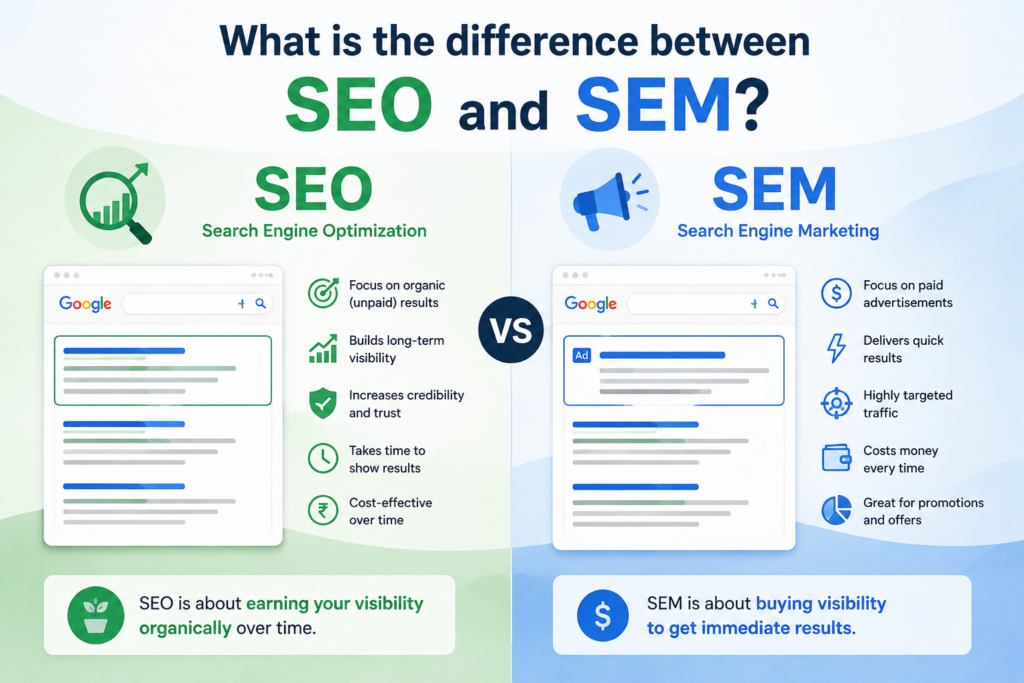
seo-vs-sem-comparison-chart-2026.pngAlt Text: Infographic comparing SEO and SEM metrics, highlighting differences in cost, time to results, and SERP placement.
Meta Description: A visual breakdown of the key structural and financial differences between Search Engine Optimization (SEO) and Search Engine Marketing (SEM).
Description: A clean, modern comparison table and flowchart illustrating how organic search traffic builds long-term equity while paid search delivers immediate, targeted conversions.