
The primary difference between on-page and off-page SEO lies in where the optimization efforts take place: on-page SEO involves everything you do directly on your website—such as optimizing content, keyword placement, meta tags, and site speed—to make it search-engine friendly and valuable to users, whereas off-page SEO encompasses all external actions taken outside your website—primarily link building, social media marketing, and brand mentions—to build your site’s overall authority, credibility, and trustworthiness in the eyes of search engines.If you are looking to grow your website’s organic traffic, understanding Search Engine Optimization (SEO) is essential. At its core, SEO is divided into two primary pillars: On-Page SEO and Off-Page SEO.
If you are looking to grow your website’s organic traffic, understanding Search Engine Optimization (SEO) is essential. At its core, SEO is divided into two primary pillars: On-Page SEO and Off-Page SEO.
While both work together to boost your rankings on search engine results pages (SERPs), they target entirely different areas of your digital footprint.
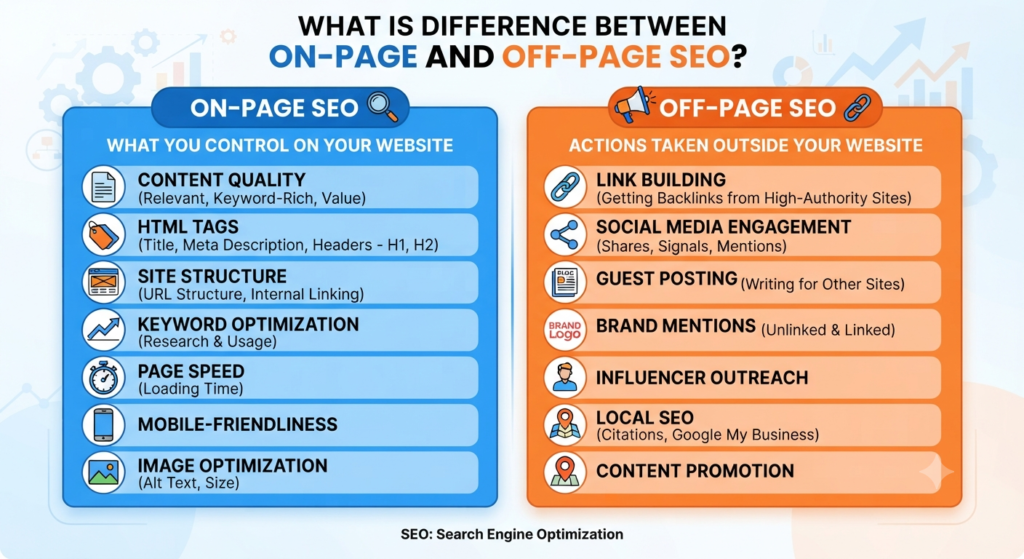
What is On-Page SEO?
On-Page SEO (also known as on-site SEO) refers to the practice of optimizing individual web pages to rank higher and earn more relevant traffic from search engines. This involves optimizing both the content and the HTML source code of a page.
Because you have total control over your website, you are in the driver’s seat for all on-page optimization elements.
What is On-Page SEO?
Content Quality: Publishing original, high-value, and engaging content that directly answers user intent.
Keyword Optimization: Strategically placing primary and secondary keywords in titles, headings, and throughout the text without keyword stuffing.
Title Tags and Meta Descriptions: Crafting compelling titles and summaries that entice users to click from the search results.
URL Structure: Keeping URLs clean, descriptive, and short (e.g.,
[yourwebsite.com/on-page-vs-off-page-seo](https://yourwebsite.com/on-page-vs-off-page-seo)).Technical Usability: Ensuring fast page load speeds, mobile responsiveness, and a clean internal linking structure
Off-Page SEO refers to all the actions taken outside of your website to impact your rankings within SERPs. Think of off-page SEO as building your website’s reputation, authority, and trustworthiness in the eyes of both search engines and users.
While on-page SEO tells Google what your site is about, off-page SEO tells Google how much people trust your site.
What is Off-Page SEO?
Link Building: Acquiring backlinks (hyperlinks from other websites to yours) from reputable, authoritative sites in your industry. This is the single biggest factor in off-page SEO.
-
-
Social Media Marketing: Promoting your content across social platforms to drive brand awareness and indirect traffic signals.
-
Guest Blogging: Writing and publishing articles on other authoritative websites within your niche to reach new audiences and earn links.
-
Brand Mentions: Getting talked about online—even without a direct link—which builds overall brand authority.
-
Collaborating with industry leaders to amplify your content and credibility
-
Key Differences at a Glance
| Feature | On-Page SEO | Off-Page SEO |
| Focus Area | Elements on your website | Elements outside your website |
| Primary Goal | Optimize content structure and relevance | Build authority, trust, and popularity |
| Control Level | High: You control your code, design, and words. | Moderate to Low: You must earn external validation. |
| Key Examples | Keyword usage, meta tags, site speed, internal links | Backlinks, social shares, guest posts, brand mentions |
Why You Need Both for Success
Relying on just one of these strategies is like trying to drive a car with only one wheel.
If you have exceptional On-Page SEO but zero off-page authority, search engines may understand your content, but they won’t trust it enough to rank it above competitors. Conversely, if you have incredible Off-Page SEO (tons of backlinks) but your website content is thin, broken, or poorly optimized, users will bounce immediately, and your rankings will eventually drop.
To achieve sustainable organic growth, you must optimize your house from the inside out (On-Page) while building a stellar reputation in the wider neighborhood (Off-Page).
Pro Tip: Always focus on nailing your on-page optimization first so your website is valuable and functional, then aggressively pursue off-page strategies to scale your authority.