
In today’s hyper-saturated digital marketplace, capturing consumer attention has become harder than ever. Traditional advertising channels—such as banner ads, billboards, and generic television commercials—are increasingly met with banner blindness, ad blockers, and deep skepticism. Consumers have grown weary of direct brand pitches; instead, they turn to peers, creators, and online personalities whose opinions they respect and value.
This fundamental shift in consumer behavior has catapulted influencer marketing from an experimental tactic into a cornerstone of modern brand strategy. But if you are a business owner or marketer, you might still be asking: How do influencer collaborations actually help my brand? Is it just about vanity metrics like follower counts and likes, or does it drive genuine bottom-line growth?
In this comprehensive guide, we will unpack the multifaceted benefits of influencer collaborations, exploring how strategic partnerships can elevate your brand awareness, build unbreakable trust, supercharge your content creation engine, and directly drive sales.
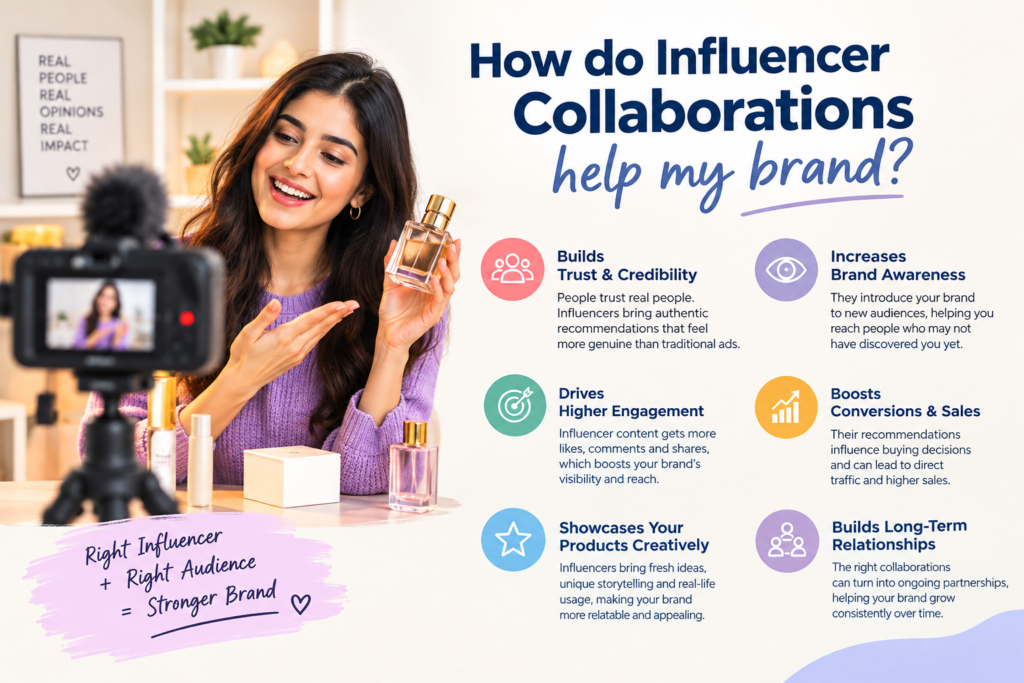
1. Bypassing Ad Fatigue and Building Instant Trust
The greatest barrier modern brands face is not reach—it is trust. Consumers are constantly bombarded with commercial messages, leading to widespread ad fatigue. When a brand promotes itself, the audience inherently understands the commercial bias. However, when an influencer recommends a product, it feels fundamentally different.
Influencers spend months or years cultivating authentic communities. They share their daily lives, expert insights, triumphs, and vulnerabilities. Over time, they build a deep parasocial relationship with their followers. When an influencer vouches for your brand, that endorsement acts as a powerful stamp of approval. Their audience trusts their judgment, allowing your brand to bypass the natural skepticism consumers feel toward traditional advertisements.
Key Insight: Trust is the currency of modern commerce. Influencer marketing succeeds because it replaces corporate monologue with peer-to-peer dialogue.
1. Bypassing Ad Fatigue and Building Instant Trust
The greatest barrier modern brands face is not reach—it is trust. Consumers are constantly bombarded with commercial messages, leading to widespread ad fatigue. When a brand promotes itself, the audience inherently understands the commercial bias. However, when an influencer recommends a product, it feels fundamentally different.
Influencers spend months or years cultivating authentic communities. They share their daily lives, expert insights, triumphs, and vulnerabilities. Over time, they build a deep parasocial relationship with their followers. When an influencer vouches for your brand, that endorsement acts as a powerful stamp of approval. Their audience trusts their judgment, allowing your brand to bypass the natural skepticism consumers feel toward traditional advertisements.
Key Insight: Trust is the currency of modern commerce. Influencer marketing succeeds because it replaces corporate monologue with peer-to-peer dialogue.
2. Hyper-Targeted Access to Niche Audiences
Mass marketing is often inefficient and expensive. Casting a wide net via traditional media means you pay to reach millions of people who have zero interest in your product. Influencer marketing, by contrast, offers surgical precision.
No matter how specialized your niche is—whether you sell sustainable kitchenware, B2B SaaS tools, vegan skincare, or ultra-performance cycling gear—there are creators who have built dedicated communities around those exact topics. By collaborating with niche or micro-influencers, you gain immediate, frictionless access to an audience that is pre-qualified and genuinely interested in your industry category
3. Supercharging Your Content Creation Engine
Producing fresh, engaging, high-converting content on a consistent basis is one of the greatest operational challenges for marketing teams. Photoshoots, video production, copywriting, and editing require immense time, talent, and financial resources.
Influencer collaborations solve this bottleneck effortlessly. Professional creators are, at their core, talented content producers. When you partner with them, you aren’t just paying for distribution; you are paying for world-class, authentic user-generated content (UGC). Creators know exactly what resonates with their audience—whether it’s unboxing videos, aesthetic lifestyle reels, honest review tutorials, or comedic skits
Once content is created through a collaboration, smart brands repurpose it across multiple touchpoints:
Paid Social Ads: Running whitelisted influencer posts as spark ads or paid ads yields significantly higher conversion rates than polished corporate ads.
Website Product Pages: Embedding creator video reviews directly onto product description pages dramatically increases buyer confidence.
Email Marketing: Incorporating real creator testimonials and imagery into newsletters boosts click-through rates.
4. Accelerating Brand Awareness and Social Proof
For emerging brands, breaking through the noise and establishing brand recognition is an uphill battle. When you launch a campaign with multiple influencers simultaneously, you create a powerful “halo effect”. Suddenly, your target audience sees your product featured naturally across their favorite feeds, stories, and video platforms.
This omnipresence creates instant social proof. Potential customers think, “Everyone is talking about this brand; it must be legitimate and high quality.” This collective visibility drastically shortens the customer journey from discovery to purchase.
5. Direct Impact on SEO and Digital Footprint
Beyond immediate social media engagement, influencer collaborations provide long-term organic search benefits. When reputable creators write blog posts reviewing your product, feature you in YouTube video descriptions, or link to your store from their resource pages, your brand earns high-authority backlinks.
These backlinks signal search engines like Google that your website is credible and authoritative, ultimately improving your organic search rankings and driving sustainable, long-term traffic to your e-commerce store.
6. Measurable ROI and Performance-Driven Partnerships
Early influencer marketing was often criticized for lacking accountability, relying solely on vanity metrics like follower counts. Today, the landscape has matured dramatically. Modern influencer collaborations are backed by sophisticated tracking tools, custom UTM links, exclusive discount codes, and affiliate commission structures.
Brands can track exact Key Performance Indicators (KPIs), including:
Cost Per Acquisition (CPA)
Return on Ad Spend (ROAS)
Discount code redemption volume
Website traffic surges during campaign windows
Net follower growth and engagement spikes
By structuring partnerships around performance—such as offering commission on sales generated—brands can mitigate financial risk while aligning incentives with the creator.