
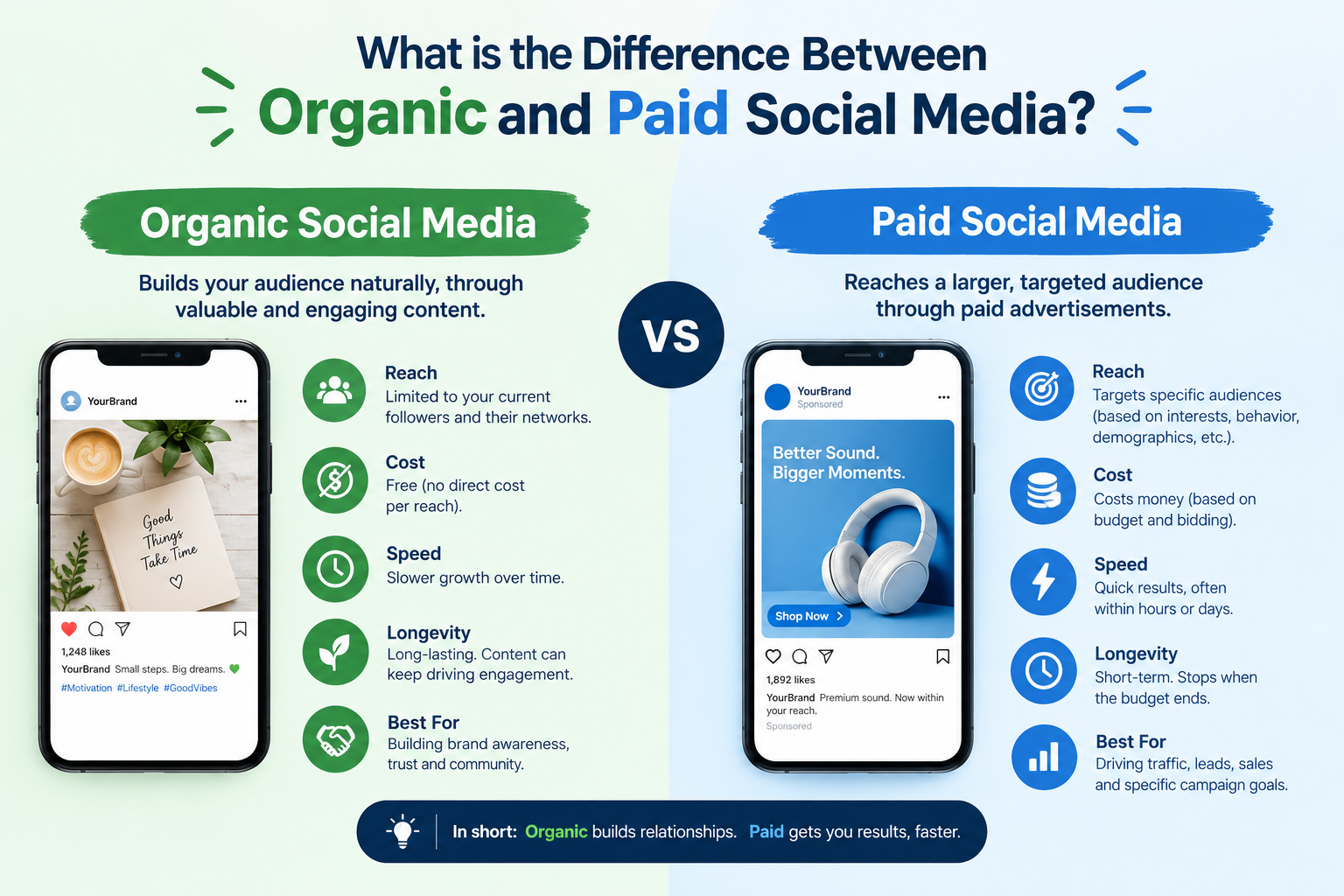
In the modern digital landscape, social media is no longer just a digital scrapbook or a casual networking tool—it is a core engine driving modern business growth, brand loyalty, and customer acquisition. However, when businesses sit down to map out their digital marketing blueprint, a common question arises: Should we focus on organic social media, or should we invest heavily in paid ads?
The short answer? It shouldn’t be an “either/or” choice. Both organic and paid social media serve distinct purposes, target different behaviors, and yield completely different results. Understanding the fundamental differences between the two is the key to building a resilient, high-performing marketing strategy.
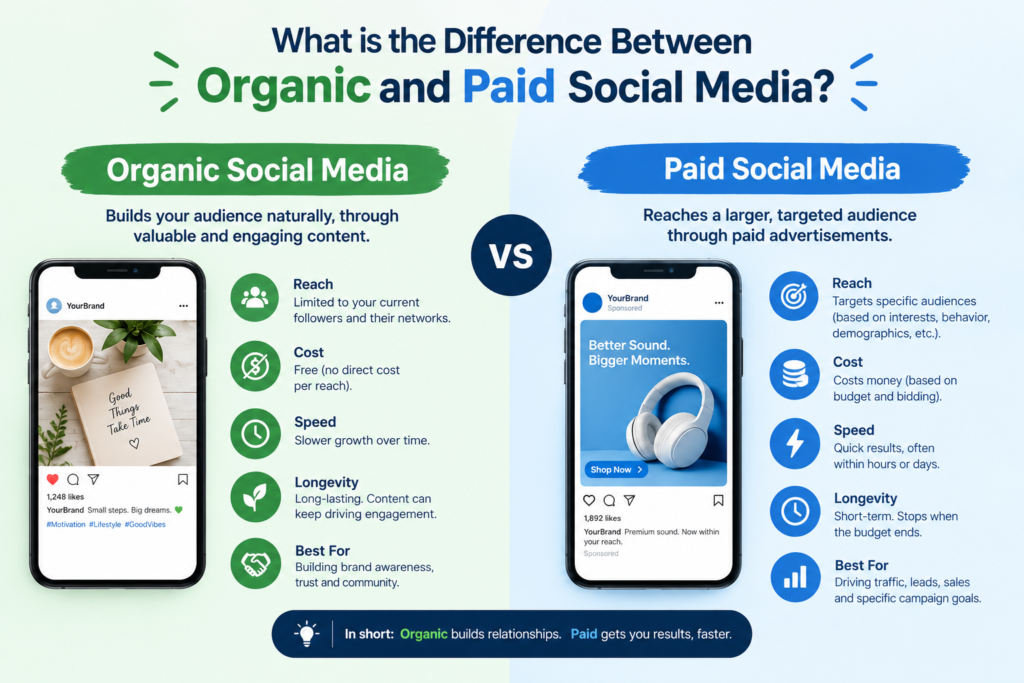
What is Organic Social Media?
Organic social media refers to the free content that brands and individuals post on social platforms—such as standard feed posts, Stories, Reels, tweets, and community replies. When you publish a post without putting any advertising budget behind it, you are relying entirely on the platform’s organic algorithms and your existing follower base to gain visibility.
The Core Pillars of Organic Social
Relationship Building: Organic content focuses on human connection, sharing brand values, showcasing behind-the-scenes processes, and engaging in two-way conversations.
Community Engagement: It serves as a customer service touchpoint where brands can directly reply to comments, direct messages, and reviews.
Long-Term Brand Authority: Consistent organic publishing builds a library of content that tells your brand’s story over time, establishing trust and credibility.
Advantages of Organic Social Media
Cost-Effectiveness: Aside from the time, copywriting, and graphic design resources required to produce it, publishing organic content costs nothing in direct ad spend.
Authenticity and Trust: Because organic posts aren’t explicitly pushing a hard sale, they feel more genuine. Consumers often view organic profiles as a true reflection of a brand’s personality.
Compound Growth: Over months and years, a healthy organic presence creates lasting community loyalty, word-of-mouth referrals, and organic search visibility.
Disadvantages of Organic Social Media
The Algorithm Bottleneck: Social media platforms are businesses, too. Over the years, algorithms have drastically reduced organic reach. Today, a standard organic post on platforms like Facebook or Instagram typically reaches only a tiny fraction (often 2% or less) of your actual followers unless it triggers massive initial engagement.
Slow Momentum: Organic growth is a marathon, not a sprint. It takes consistent effort, patience, and repetition to build an audience from scratch.
Limited Control Over Target Audience: You cannot easily dictate who sees your organic posts; your visibility is restricted to existing followers, profile visitors, and people who happen to browse specific hashtags.
What is Paid Social Media?
Paid social media involves allocating financial budget to social networks (such as Meta, LinkedIn, TikTok, or Pinterest) to promote content, display targeted ads, or sponsor posts. Instead of waiting for the algorithm to naturally distribute your content, you are trading budget for guaranteed distribution, visibility, and precise audience reach
Common Paid Social Formats
Boosted Posts: Taking an existing high-performing organic post and putting money behind it to push it out to a wider audience.
Targeted Feed & Story Ads: Specially designed graphic, carousel, or video advertisements built within ad managers (like Meta Ads Manager) designed to interrupt a user’s scroll with a clear call-to-action (CTA).
Influencer Partnerships & Sponsored Collaborations: Paying creators or industry partners to showcase your products to their dedicated follower bases.
Advantages of Paid Social Media
Precise Hyper-Targeting: Paid social allows you to slice and dice audience data with incredible accuracy. You can target users based on geographical location, age, exact interests, purchasing behaviors, job titles, or custom lookalike audiences derived from your existing customer database.
Immediate Results and Scalability: Unlike organic marketing, which takes months to gain traction, a well-configured paid ad campaign can drive traffic, leads, and sales within hours of approval.
Measurable ROI: Advanced tracking pixels, conversion APIs, and robust analytics dashboards make it straightforward to measure your cost-per-click (CPC), customer acquisition cost (CAC), and overall return on ad spend (ROAS).
Disadvantages of Paid Social Media
Financial Commitment Required: Paid social requires ongoing capital. If you turn off your ad budget, your traffic and conversions typically drop right back to baseline.
Ad Fatigue and Saturation: Users see hundreds of ads a day. Overexposure to the same creative can lead to ad fatigue, where target audiences tune out or hide your ads, driving up costs.
Perceived Lack of Authenticity: Explicitly promotional ads can sometimes face skepticism from consumers who prefer genuine peer recommendations over brand advertising
Head-to-Head Comparison: Organic vs. Paid Social Media
To better understand how these two strategies stack up against each other across critical business metrics, review the breakdown below:
| Feature | Organic Social Media | Paid Social Media |
| Primary Cost | Time, creative production, and resource management | Direct ad spend budget + management expertise |
| Speed of Results | Slow and cumulative over time | Instant visibility and rapid conversion scaling |
| Audience Reach | Mostly restricted to existing followers and algorithm picks | Highly scalable to cold, warm, and custom target segments |
| Targeting Control | Low (dependent on platform algorithms and hashtags) | High (granular control over demographics, behaviors, and traits) |
| Primary Goal | Building long-term trust, community, and brand loyalty | Driving specific actions, leads, traffic, and sales |
| Lifespan | Temporary post visibility that fades quickly | Active as long as the campaign budget runs |
When Should You Use Organic Social Media?
Organic social media should serve as the beating heart and identity of your brand online. Lean heavily into an organic strategy when your goals focus on:
Establishing Brand Presence: Building a clean, active profile so that when prospective customers look you up, they see a living, breathing business.
Content Testing: Testing different messaging angles, visual styles, hooks, and content formats to see what naturally resonates with your audience before spending money on them.
Community Nurturing: Fostering deep relationships with existing clients, answering support queries, and highlighting user-generated content (UGC).
When Should You Use Paid Social Media?
Paid social media acts as the fuel injection for your business growth. Deploy paid advertising strategies when you need to:
Launch New Products or Offers: When you have a time-sensitive promotion, event, or product drop that requires immediate mass awareness.
Overcome Algorithm Ceilings: When your organic reach has flatlined and you need to break out of your echo chamber to find entirely new customer segments.
Retarget Website Visitors: Re-engaging users who previously visited your website or abandoned their shopping carts but didn’t complete a purchase.
The Winning Formula: Building a Hybrid Strategy
The most successful brands do not choose between organic and paid social media—they integrate them into a cohesive, cyclical ecosystem.
Use Organic as Your Testing Ground: Publish your regular educational tips, product highlights, and creative videos organically. Monitor your analytics closely to see which posts organically capture the highest engagement, comments, saves, and shares.
Amplify Top Performers: Once you identify an organic post that clearly resonates with your audience, put ad spend behind it. By “boosting” or setting up a paid campaign around proven organic content, you remove the guesswork and ensure your advertising budget supports creative that already has a verified track record.
Bridge the Trust Gap: When paid ads successfully introduce new cold audiences to your brand, those users will frequently click through to view your main social profile. A robust, active organic feed reassures them that your business is reputable, authentic, and established.
By blending the trust-building nature of organic social media with the precision and scale of paid ads, you create a balanced marketing engine capable of building a loyal community while consistently driving bottom-line revenue.
What does your current social media mix look like? Are you leaning more toward organic community-building or paid acquisition right now?